
Riprap & Shoreline Stabilization
Riprap Installation on a Central Florida Lakefront: How We Stopped a Shoreline From Washing Into the Lake
A lakefront bank was losing ground to every storm and boat wake and dumping soil straight into the water. Here is how we rebuilt it with filter fabric and graded granite riprap, and why it will hold.
ISA Certified Arborist FL-9716A · FSESCI Qualified Inspector · Florida GI-BMP Certified · Veteran-Owned
A shoreline that was quietly disappearing
This one started the way most shoreline jobs do. Nobody woke up to a collapsed bank one morning. It went a few inches at a time, over a couple of rainy seasons, until the grass line was several feet back from where it used to be and there was a raw dirt edge dropping straight into the water.
By the time we walked it, the bank was bare soil. Every heavy Central Florida afternoon storm was rinsing sand off the slope and carrying it into the lake, and the boat wakes rolling in off the main body of water were chewing at the toe of the bank from the other direction. Water was working it from the top and the bottom at the same time. There was also a stormwater pipe running down toward the water, and the spot where it let out had cut a little gully of its own.
Left alone, this only goes one way. The bank keeps retreating, the lake gets muddier, and eventually it starts undermining whatever is uphill, which around here is usually a seawall, a dock footing, a patio, or an irrigation line.
Why riprap, and not sod or a seawall
There is more than one way to fix an eroding bank, and we do not throw rock at every problem. Sod and plantings work when the slope is stable and the water is calm. A seawall works when you want a hard vertical edge and you are ready to permit and pay for it. This site was in between. It had moving water from two directions, a stormwater outfall dumping right through the work area, and a slope that needed to stay a slope.
Riprap fits that exactly. It is graded stone placed over a filter layer, and it works by absorbing energy instead of fighting it. Wave and wake energy hits the rock and dies in the gaps between stones instead of pulling soil off a smooth face. Stormwater coming out of the pipe spreads through the rock instead of cutting a channel. And it is permanent. Done right, riprap is a thirty-year fix you basically leave alone, which is a very different conversation than re-sodding the same bank every couple of years.
It also solved the outfall. We could set the rock so the pipe daylights right into the armored zone, so the water it carries lands on stone and not on bare dirt. That one detail fixed half of what was going wrong here.
What we actually did
The rock is the part everyone sees, but the rock is not what makes it hold. What makes it hold is everything underneath it, and the order you do it in.
First we cut the slope back to firm ground and shaped it. A riprap bank needs a consistent grade so the stone sits in a stable layer instead of bridging over soft spots. We pulled the loose, sloughing material off and set the angle of the bank so the rock would lock in instead of roll.
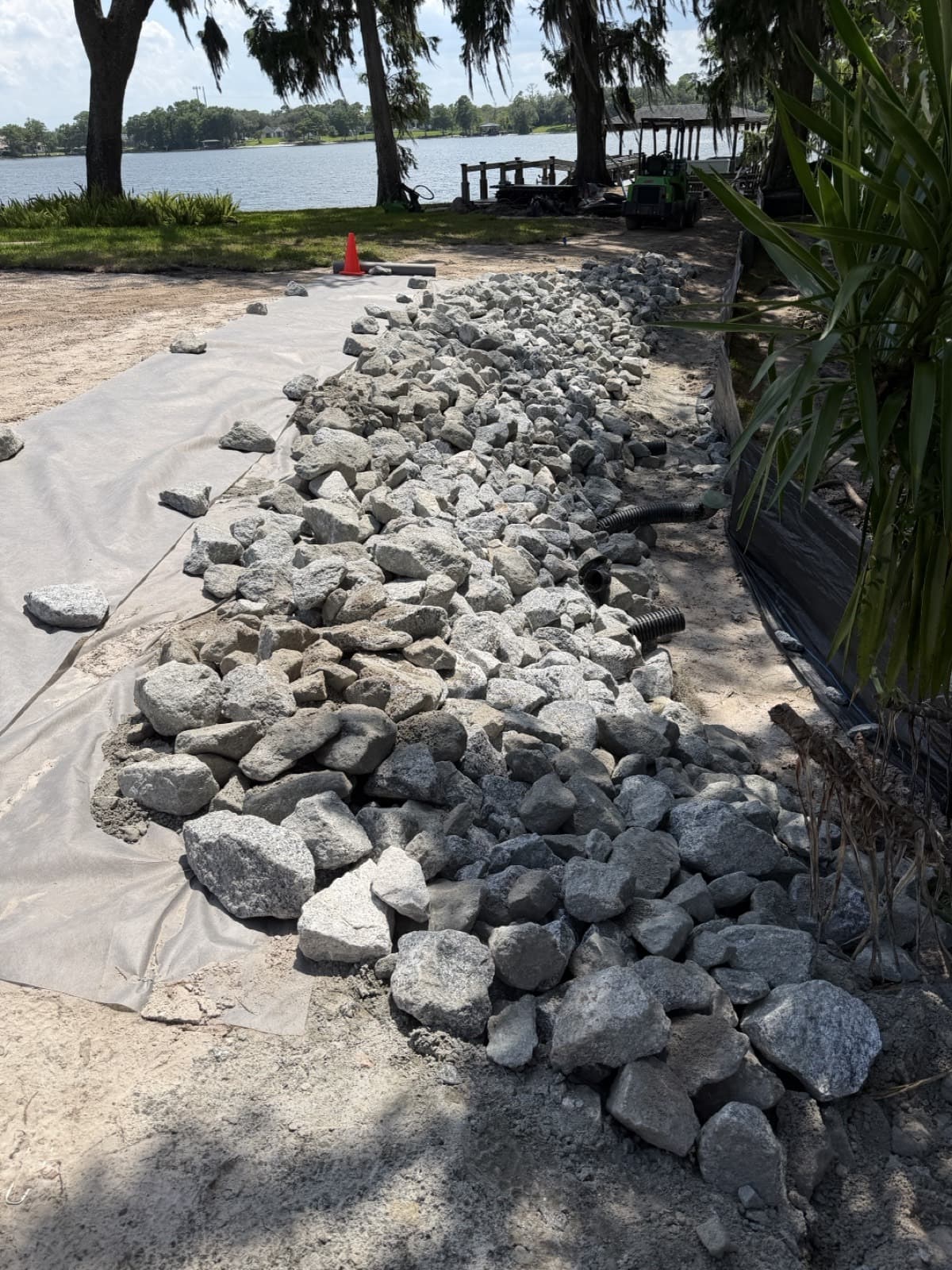
Then came the filter fabric. That is the layer in the photo that looks like it does not matter, and it is the single most important thing on the job. We laid a heavy woven geotextile across the whole prepared slope, overlapped the seams, and ran it up past the top of the rock line. The fabric lets water pass through but holds the soil behind it. Without it, water moves in and out through the rock and slowly pumps the sand out from underneath, and the bank settles and fails from the inside. Rock on bare dirt is not riprap. It is a pile of rock waiting to sink.
We tied the stormwater outfall into that fabric layer so the pipe discharges onto the armored surface, then started placing stone. This was granite riprap, a graded mix of sizes rather than all one size, because the smaller pieces knit into the gaps between the big ones and lock the whole mass together. We keyed it in deep at the toe, below the waterline, so wave action cannot scoop under the bottom edge and unzip it. From there we built the layer up the slope to thickness and blended it into grade at the top.
The last piece runs the whole time: keeping our own work from making the lake worse. We kept silt fence and sediment controls in place along the water side through the entire install, so the soil we disturbed stayed on the bank and out of the lake. That is not optional near open water in Florida, and honestly it is the part a lot of crews skip. We do not.
Why it holds
Put together, each layer does one job. The graded stone takes the hit from waves, wakes, and stormwater and turns that energy into nothing. The filter fabric keeps the soil where it belongs while still letting groundwater breathe through. The keyed toe anchors the bottom so nothing can start peeling it up. And the whole slope sits at an angle where the rock wants to stay put.
There are no moving parts and nothing to maintain. After a big storm you might have a stray rock to reset, but you are not rebuilding a bank every year. That is the entire reason to do it in stone instead of chasing it with sod.
The details that decide whether it lasts
If you are looking at riprap for your own shoreline, these are the things that separate a job that holds from one that slides into the lake in two years.
- Filter fabric, every time. If someone quotes you rock on bare dirt, that is not a shortcut, it is a future failure. The fabric is cheap compared to redoing the whole bank.
- Stone size and gradation matter. Too small and the water moves it. All one size and it never interlocks. Graded granite in the right size range for the energy on your bank is what stays put.
- Key the toe below the water. The bottom edge is where riprap fails first, because that is where the energy concentrates. If it is not set deep enough at the waterline, the lake will find the bottom edge and work its way up.
- Control the sediment while you build. Shoreline work in Florida means working right at the water. Keeping disturbed soil out of the lake during construction is the right thing to do, and on a lot of sites it is also required.
A note on permits
Shoreline work in Florida often sits in a regulated zone, because you are building at or below the ordinary high water line of a water body. Depending on the lake, the county, and how much of the bank you are armoring, riprap can require review from the water management district or another agency before you start. On smaller residential repairs it is frequently straightforward, but it is not something to guess at. Part of what we do is figure out which bucket your project falls in before rock ever shows up, so you are not the one explaining an un-permitted shoreline to an inspector later.
If your bank is going the same way
If you have a lake or pond edge losing ground, the earlier you deal with it the cheaper it is. A foot of bank you catch this year is a lot less rock than the collapse you are staring at after two more rainy seasons. Riprap is not the answer for every shoreline, but when there is real water energy and a slope worth keeping, it is usually the one that ends the problem instead of postponing it.
This is the kind of work we do across Seminole, Orange, Lake, and Volusia counties, on lakefronts, retention ponds, drainage outfalls, and anywhere moving water is taking soil it should not. If that sounds like your property, send us a few photos and we will tell you honestly whether you need rock or something simpler.