
ISA Certified Arborist · Central Florida
Construction Tree Monitoring, Inspections and Reporting
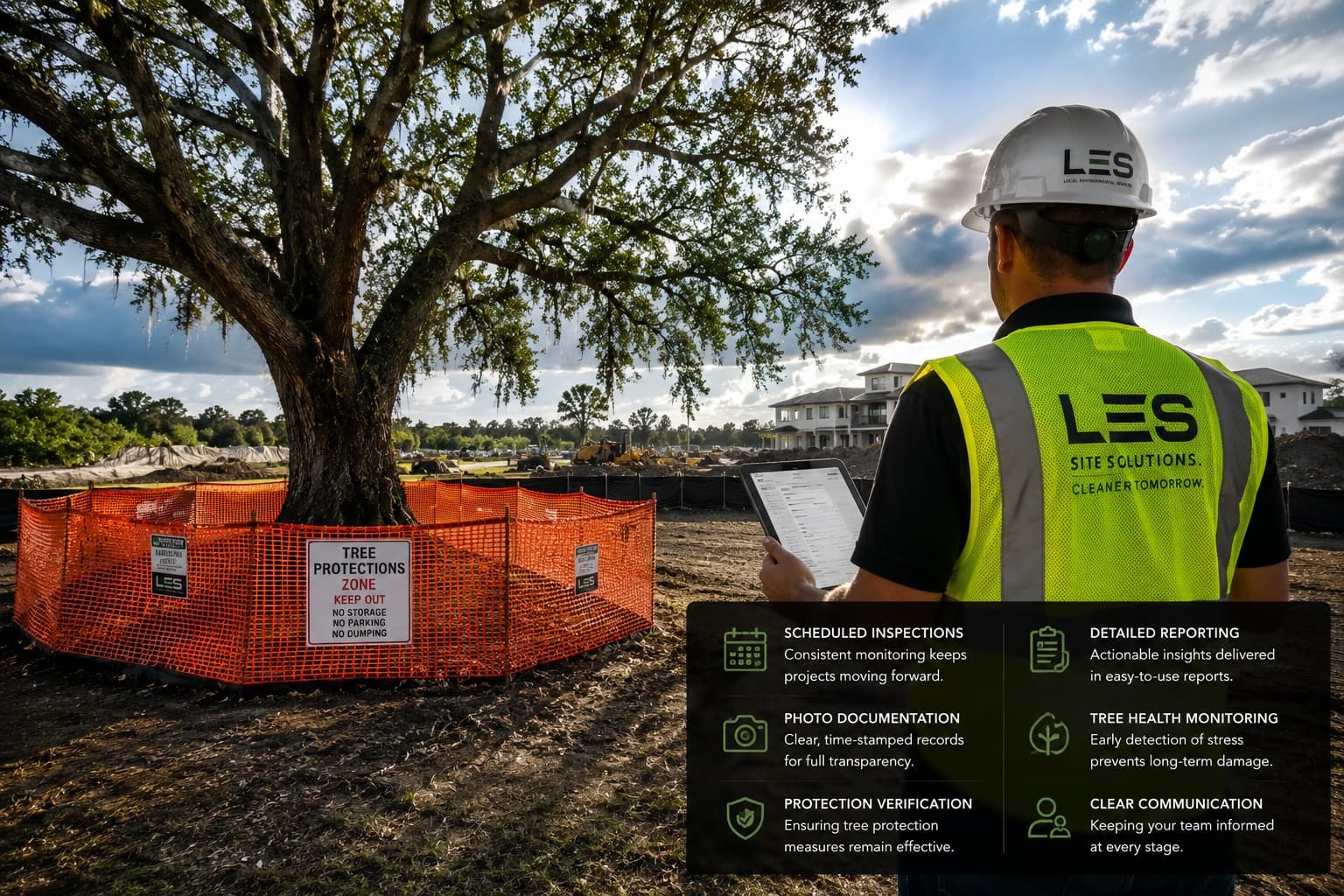
Tree protection is not a one-time installation. Active construction sites change constantly, and protected trees require continued monitoring, maintenance, and documentation. LES gives the project team clear field information and actionable recommendations from baseline through closeout.
Speak with the arborist directly: 407-502-6476
ISA Certified Arborist
FL-9716A
Photo-documented reporting
Records for the project file
Scheduled & event-driven
Routine, milestone, post-storm
Central Florida coverage
Seminole · Orange · Lake · Volusia
Why Ongoing Monitoring Matters
The Site That Passed Inspection Last Week Has Already Changed
Protection installed on day one is only as good as the day it was last verified. Trades move, fences come down, roots get exposed, and stress builds quietly. Monitoring keeps protection real for the length of the build and gives the team an early warning before a problem becomes permanent.
- Fencing moved, damaged, or removed by other trades
- Unauthorized access into protection zones
- Root-zone traffic and equipment inside the critical root zone
- Material storage and stockpiling over protected roots
- Soil compaction that isn't visible until decline sets in
- Trenching and utility work near retained trees
- Grade changes that bury or expose root systems
- Washout, concrete slurry, or fuel contamination
- Mechanical damage to trunks and scaffold limbs
- Canopy strikes from cranes, lifts, and haul trucks
- Irrigation and drainage changes that alter the root environment
- Exposure and wind load after neighboring trees are removed
- Stress symptoms that develop gradually over the build
Tree Protection Inspections
Verified on Schedule and on Call
- Scheduled routine inspections while the site is active
- Pre-activity inspections before clearing, trenching, or utility work
- Post-storm inspections after significant weather
- Post-clearing inspections once adjacent work is done
- Inspections after a reported incident or equipment strike
- Verification of fencing, barricades, signage, root and trunk protection
- Identification of encroachment and unauthorized access
- Documentation of deficiencies with recommended corrective action
- Direct communication with site leadership
Tree Protection Maintenance
Keep Protection Functional, Not Just Installed
- Repairing damaged tree protection fencing
- Resetting displaced barricades
- Replacing missing or illegible signage
- Closing unauthorized access points
- Restoring protection-zone visibility
- Maintaining root and trunk impact protection systems
- Adjusting systems when authorized construction sequencing changes
- Coordinating corrective work with the superintendent or project manager
- Documenting repairs for the project record
LES does not override approved plans or municipal requirements. Changes to protection are coordinated and authorized with the project team.
Pre-Construction Tree Condition Reporting
Establish the Baseline Before the First Disturbance
A baseline condition report captures each protected tree before work begins — species and size, visible defects, canopy and trunk condition, root-zone observations, existing damage, and site constraints, with photographic documentation and protection recommendations. It also flags any tree that warrants additional evaluation.
The level of detail depends on the project scope and agreement. The point is simple: document the starting condition so construction impacts can be measured against a real baseline, not a memory.
Tree Health Monitoring During Construction
An Early-Warning System for the Project Team
Construction stress rarely shows up all at once. LES watches for the signs that a protected tree is under pressure and flags changes that call for corrective action or further evaluation — while there is still time to respond.
Incident & Impact Documentation
Objective Records, Not Accusations
When something happens on site, the record should be factual and professional. LES documents the observed condition, the timeline and location, photo evidence, and recommended next steps — including emergency stabilization recommendations where warranted — in a format suitable for project records.
- Equipment strikes to trunks and limbs
- Root cutting from trenching or grading
- Unauthorized trenching in the protection zone
- Soil or concrete washout exposure
- Stockpiling inside protection zones
- Grade changes over the root zone
- Canopy damage
- Fence removal or relocation
- Storm damage
Post-Construction Reporting
Close the Loop at the End of the Job
At closeout, LES can compare final condition to the baseline, review protection-system removal, note visible construction impacts and any remaining concerns, and record tree-health observations with closeout photographs.
Where appropriate, the report recommends post-construction care — watering, mulching, soil remediation, pruning, monitoring, or further evaluation — and a long-term monitoring approach for trees that experienced meaningful impact.
Reporting Deliverables
Records Built for the Project File
- Photo-documented inspection reports
- Date and weather conditions
- Site area or tree identification
- Condition observations
- Deficiencies noted objectively
- Corrective actions recommended
- Priority level
- Responsible-party coordination notes
- Before-and-after photos
- Closeout summaries
- Digital records suitable for project files
Specific report formats are available or scope-dependent and confirmed with your team before work begins.
Inspection Frequency Options
Structured Around Your Schedule
Project Team Value
Monitoring Supports the Whole Team
Better field communication, clear documentation, early damage identification, faster corrective action, fewer disputes, stronger permit and plan compliance, and better closeout records — with a higher likelihood that preserved trees actually survive.
Developers & owners
Documentation that protects the investment and supports successful tree preservation at closeout.
General contractors & superintendents
Early identification of damage, faster corrective action, and fewer field disputes.
Civil contractors
Clear coordination on root-zone and utility conflicts before they become rework.
Municipal inspectors
Consistent, objective records that support permit and plan compliance.
Landscape architects & engineers
Field-verified condition reporting that feeds back into the plan.
HOAs & associations
A defensible record of how community trees were protected through construction.
How the Process Works
From Baseline to Closeout
- 01
Establish baseline condition
Document each protected tree before construction — species, size, canopy, trunk, root-zone observations, and existing damage, with photos.
- 02
Confirm protection measures
Verify installed fencing, barricades, signage, and root and trunk protection against the approved plan.
- 03
Set inspection schedule
Structure monitoring around the construction schedule — routine, milestone, pre- and post-activity, and post-storm inspections.
- 04
Inspect & document
Walk the site on schedule and on call, documenting conditions, deficiencies, and tree health with photo records.
- 05
Communicate deficiencies
Report findings to site leadership with objective observations and recommended corrective action and priority.
- 06
Verify & close out
Confirm corrective action, then complete post-construction and closeout reporting when included in scope.
Service Area
Construction Tree Monitoring Across Central Florida
LES monitors protected trees on active development sites throughout Seminole, Orange, Lake, and Volusia counties — coordinating inspections around construction activity from Lake Mary and Sanford through Orlando and out to the Volusia coast.
Construction Tree Monitoring & Reporting FAQ
How often should protected trees be inspected during construction?
It depends on the project, but protected trees should be checked on a regular schedule, before and after major activities like clearing and trenching, and after significant storms. LES structures monitoring around your construction schedule — weekly, biweekly, monthly, milestone, or on-call — so inspections line up with the activities most likely to affect the trees.
What is included in a tree protection inspection report?
A LES inspection report can document the date and weather, the site area or tree identification, condition observations, deficiencies, recommended corrective actions, a priority level, coordination notes, and photographs. The exact contents depend on the project scope and agreement.
Can LES inspect after a tree protection violation or equipment strike?
Yes. On-call incident inspections are part of monitoring. After a reported strike, root cut, unauthorized trenching, or fence removal, LES can document the condition objectively, record the timeline and location, and recommend next steps — including emergency stabilization recommendations where warranted.
Why is pre-construction tree documentation important?
A baseline record of each tree's condition before work begins is what makes later changes meaningful. It establishes the starting point for species, size, canopy, trunk, and root-zone condition, so any construction impact can be identified against a documented baseline rather than argued from memory.
What signs show that a tree is declining during construction?
Warning signs include thinning canopy, off-color or premature leaf drop, branch dieback, wilt, bark and trunk damage, and visible root-zone disturbance or compaction. Many appear gradually, which is why ongoing monitoring acts as an early-warning system for the project team.
Does LES repair tree protection fencing?
Yes. Protection maintenance includes repairing damaged fencing, resetting barricades, replacing signage, closing unauthorized access points, and restoring protection-zone visibility. Changes to the approved protection are coordinated and authorized with the project team, not made unilaterally.
Can inspections be scheduled around major construction activities?
Yes. Monitoring can be tied to milestones and to specific activities — before clearing, before trenching or utility work, and after adjacent trees are removed — so protection is verified at the moments that matter most.
What is included in a post-construction tree report?
A post-construction report can compare final condition to the baseline, review protection-system removal, note visible construction impacts and remaining concerns, and recommend post-construction care such as watering, mulching, soil remediation, pruning, or further monitoring, with closeout photographs.
Can reports include photographs and corrective-action recommendations?
Yes. Photo documentation and objective, factual corrective-action recommendations are core parts of LES reporting, written to be suitable for the project record rather than adversarial.
How long should trees be monitored after construction?
Construction stress can take a season or more to appear, so post-construction monitoring is often recommended for a period after the work is complete. The appropriate duration depends on the trees, the level of impact, and the project — LES will recommend a monitoring approach when it applies.
Build a Tree Monitoring Program
Send the site address, the construction phase, the number of protected trees, and how often you need eyes on them. LES will return a monitoring approach and pricing, typically within one business day.
- ISA Certified Arborist FL-9716A
- Scheduled, milestone, post-storm & on-call inspections
- Photo-documented reports suitable for the project file
- Serving Seminole, Orange, Lake & Volusia Counties
Related Services
Maintain protection. Document conditions. Catch problems early.
Set up scheduled and event-driven tree monitoring so protection stays functional, conditions are documented, and problems are caught while there's still time to respond.