
ISA Certified Arborist · Central Florida
Tree Protection Planning and Installation for Central Florida Construction Projects
Protect designated trees before construction activity creates damage, delays, mitigation costs, or compliance problems. LES helps developers, builders, and contractors turn approved tree preservation requirements into practical field protection systems that work alongside clearing, grading, utilities, access, and vertical construction.
Speak with the arborist directly: 407-502-6476
ISA Certified Arborist
FL-9716A
Active construction sites
Grading, utilities, vertical
Central Florida coverage
Seminole · Orange · Lake · Volusia
Photo-documented field reporting
Records built for the project file
Why Tree Protection Fails During Construction
Marked for Preservation Is Not the Same as Protected
Trees are damaged on construction sites every day — even trees the plan set out to save. Most of the damage is preventable, and most of it happens because the approved plan never fully reached the field. LES is the company that connects the plan to the crews actually doing the work.
- Root-zone compaction from equipment, traffic, and staging over the critical root zone
- Trenching and utility installation cut through structural roots the plan intended to keep
- Grade changes — fill or cut — that bury or expose root systems
- Equipment strikes to trunks, scaffold branches, and exposed roots
- Material and stockpile storage inside the protection zone
- Soil contamination from concrete washout, fuels, and construction runoff
- Fencing installed in the wrong location, too small, or not to the critical root zone
- Canopy conflicts with cranes, lifts, and the building envelope handled reactively
- Unauthorized entry into protection zones once the fence is up
- Barricades knocked down, moved, or never re-set after an activity
- A disconnect between the approved plan on paper and the crews working in the field
Tree Protection Planning
Turn the Approved Plan Into a Field Protection Approach
Planning is where preventable damage gets designed out — before a blade touches the ground. LES reviews what has already been approved and builds a protection approach that fits the real construction sequence.
- Review of approved site plans, tree surveys, preservation plans, and permit conditions
- Identification and field-marking of trees designated for preservation
- Tree protection zone layout tied to the critical root zone
- Critical root zone and structural root considerations for each retained tree
- Construction access, haul-route, and equipment-conflict review
- Utility and trenching conflict review against protected root zones
- Material staging and stockpile coordination away from protection zones
- Recommended protection specifications for the site and species
- Field constructability review — will the plan actually work with the sequence
- Coordination with project managers, superintendents, civil contractors, landscape architects, and municipal inspectors
- Preconstruction documentation before clearing and mobilization
- Tree-specific recommendations where standard fencing is not enough
LES provides arboricultural field services and does not provide professional engineering, land surveying, or legal services. Planning is coordinated with the project’s engineers, surveyors, and design team.
Root & Trunk Impact Protection Systems
Protect the Parts of the Tree You Can’t See Fail
Most construction damage happens below grade and at the trunk, where it isn’t obvious until the tree declines a season or two later. These are project-specific recommendations, installed in accordance with applicable plans, specifications, and site conditions.
Root-zone protection
Protection of the critical root zone from compaction, traffic, and disturbance during active work.
Temporary load distribution
Construction matting or approved protective surfaces where limited access across a root zone is unavoidable, applied as a project-specific recommendation.
Mulch and buffering systems
Mulch layers and buffering to cushion the root zone and moderate soil moisture where appropriate.
Trunk armoring
Protective wood assemblies and trunk armoring on trees exposed to equipment routes, staging, and access lanes.
Equipment-impact protection
High-visibility protection around vulnerable trees near access roads, parking, utility corridors, and active equipment.
Corrective recommendations
Practical recommendations when work must occur near a protected root zone, installed in accordance with applicable plans, specifications, and site conditions.
Tree Protection Barricades & Fencing
Build an Enforceable Exclusion Zone
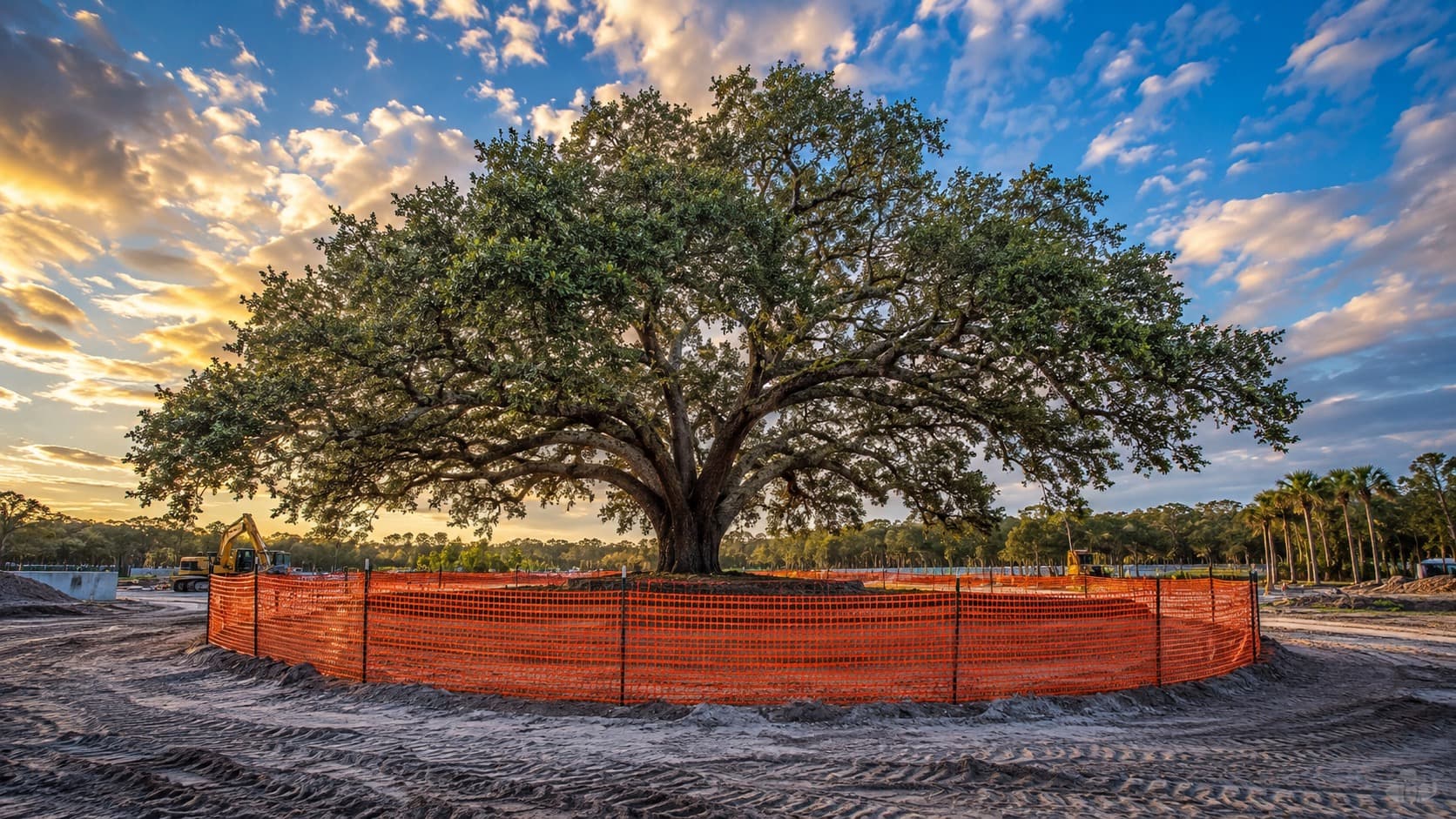
The goal is not simply to install fencing. It is to establish a clearly defined, enforceable exclusion zone that field crews recognize and respect through the whole build.
- High-visibility tree protection fencing and barricade layout
- Durable, construction-grade protection systems built to survive an active site
- Protection-zone signage and clear identification
- Access control that establishes an enforceable exclusion zone
- Installation before clearing, grading, demolition, or mobilization
- Repair, reset, and relocation when authorized by the project team
- Verification that protection stays functional throughout construction
Canopy Clearance Prescription Pruning
Arborist-Prescribed Clearance, Not Indiscriminate Cutting
Clearance pruning is prescribed by an arborist based on tree health, structure, species, site conditions, construction needs, and long-term preservation. The arborist determines whether pruning can be done without creating unacceptable tree risk or decline.
- Canopy clearance evaluations against the construction envelope and equipment
- Prescription pruning before cranes, lifts, excavators, loaders, dump trucks, and concrete trucks mobilize
- Clearance for scaffolding, temporary access, and the building envelope
- Selective canopy reduction only where arboriculturally appropriate
- Removal of dead, broken, defective, or conflicting limbs
- Structural pruning recommendations tied to long-term tree health
- No topping and no indiscriminate cutting
- Pruning coordinated with the construction sequence
- Documentation of the recommended pruning scope
Installation & Field Implementation
Mobilized to the Site, Built Into the Sequence
- Layout verification against the approved plan before installation
- Installation of tree protection fencing and barricades
- Root and trunk protection systems where specified
- Tree protection signage and zone identification
- Preconstruction photography of protected trees and conditions
- Coordination with field leadership and the construction schedule
- Identification of immediate conflicts before they cause damage
- Completion documentation and site-specific protection details
- Corrective-action recommendations when conditions require them
Project Types
Tree Protection Across the Project Types We Serve
How the Process Works
From Approved Plan to Protected Trees
- 01
Review plans & requirements
We review the approved site plan, tree survey, preservation plan, and permit conditions to confirm which trees are protected and to what standard.
- 02
Site assessment
An ISA Certified Arborist walks the site, field-marks protection zones, and identifies access, utility, grading, and canopy conflicts.
- 03
Develop field approach
We translate the plan into a practical protection approach that fits the construction sequence, equipment, and site logistics.
- 04
Coordinate with leadership
We align the approach with the superintendent, project manager, civil contractor, and any municipal inspector before installation.
- 05
Install protection systems
Fencing, barricades, root and trunk protection, and signage are installed before clearing, grading, or mobilization.
- 06
Inspect, document & maintain
We photo-document the installation, verify the exclusion zone stays functional, and recommend corrective action as the site changes.
Deliverables
What the Project Team Receives
Field-marked protection zones
Tree protection zones marked in the field and tied to the critical root zone of each retained tree.
Installed barricades & fencing
High-visibility, construction-grade fencing and barricades establishing a clear exclusion zone.
Root & trunk protection
Project-specific root-zone and trunk protection systems where site conditions require them.
Canopy clearance prescriptions
Arborist-prescribed clearance pruning scope coordinated with equipment and the building envelope.
Preconstruction photographs
Baseline photo documentation of protected trees and site conditions before work begins.
Installation documentation
A record of what was installed, where, and to what specification, suitable for the project file.
Deficiency & corrective notes
Objective notes on deficiencies and recommended corrective action as the site progresses.
Closeout documentation
Post-construction protection review and closeout documentation when included in scope.
Service Area
Tree Protection Across Central Florida
LES is based in Lake Mary and installs and coordinates tree protection on development sites throughout Seminole, Orange, Lake, and Volusia counties — from subdivisions in Sanford, Oviedo, and Winter Springs to commercial and infill projects across Orlando, DeLand, and the coast around New Smyrna Beach.
Tree Protection Planning & Installation FAQ
When should tree protection be installed on a construction site?
Tree protection should be installed before clearing, grading, demolition, or equipment mobilization — the earliest site activity is often when the most root-zone and trunk damage occurs. LES coordinates installation to the construction sequence so protection is in place before the first disturbance, not after.
Who is responsible for maintaining tree protection fencing?
Responsibility is defined by the approved plan, permit conditions, and the project contract, but fencing is only effective if it stays in place and functional. LES can install protection and verify it remains functional through construction, resetting or repairing barricades when authorized by the project team.
What is a tree protection zone?
A tree protection zone is a defined area around a retained tree — generally tied to the critical root zone — that is fenced off and excluded from construction traffic, storage, grading, and disturbance. The goal is a clearly defined, enforceable exclusion zone, not just a line of fence.
Can construction equipment operate inside a protected root zone?
As a rule, no — traffic and equipment inside the critical root zone cause compaction and root damage that can lead to gradual decline. Where limited access is unavoidable, LES can recommend project-specific measures such as temporary load-distribution matting, installed in accordance with applicable plans, specifications, and site conditions.
What happens if utilities conflict with a protected tree?
Utility and trenching conflicts are one of the most common causes of hidden root damage. LES reviews utility routing against protected root zones during planning and coordinates with the project team on alternatives — rerouting, boring, or adjusted alignments — before the trench is cut.
Can tree limbs be pruned for construction equipment clearance?
Yes, when it can be done without creating unacceptable tree risk or decline. An ISA Certified Arborist determines whether clearance pruning is appropriate based on tree health, structure, species, and site conditions, and prescribes a scope that avoids topping and indiscriminate cutting.
How often should tree protection systems be inspected?
Frequency depends on the project, but protection should be verified before major activities, after storms, and on a regular schedule while the site is active. LES offers ongoing monitoring and inspection through its construction tree monitoring and reporting service.
Can LES install protection based on an approved tree preservation plan?
Yes. LES takes approved site plans, tree surveys, and preservation plans and turns them into practical field protection — layout, fencing, root and trunk protection, and signage — installed in accordance with the plan and coordinated with the construction sequence.
Does LES provide photo-documented tree protection reports?
Yes. Preconstruction photography, installation documentation, and deficiency notes are standard parts of the scope, delivered as records suitable for the project file. The level of detail is confirmed against the project scope and agreement.
What should happen before tree protection fencing is removed?
Protection should generally stay in place until site activity near the tree is complete. Before removal, LES can perform a final review of the protected trees and site conditions and provide closeout documentation when that is included in the scope.
Request a Tree Protection Proposal
Send the site address, your approved tree or preservation plan if you have one, the construction phase, and the number of protected trees. LES will review it and return scope and next steps, typically within one business day.
- ISA Certified Arborist FL-9716A
- Installed and inspected on active construction sites
- Photo-documented field reporting for the project file
- Serving Seminole, Orange, Lake & Volusia Counties
Related Services
Protect the trees the project is required to preserve
Bring LES into the project before clearing, grading, utility installation, or equipment mobilization. Early field coordination can reduce tree damage, rework, mitigation exposure, and construction conflicts.