
Arborist & Tree Risk
A Tree Leader Failed Onto a Parked Car in Daytona Beach. Nobody Was In It. That Part Was Luck.
The canopy was green. The trunk looked solid from the parking lot. Then a leader the size of a small tree tore out of it, came down across the driver's door of a resident's car, and left a cavity you could put your arm into. Here is what that failure was telling us, and why nobody saw it coming from the ground.
ISA Certified Arborist FL-9716A · FSESCI Qualified Inspector · Florida GI-BMP Certified · Veteran-Owned
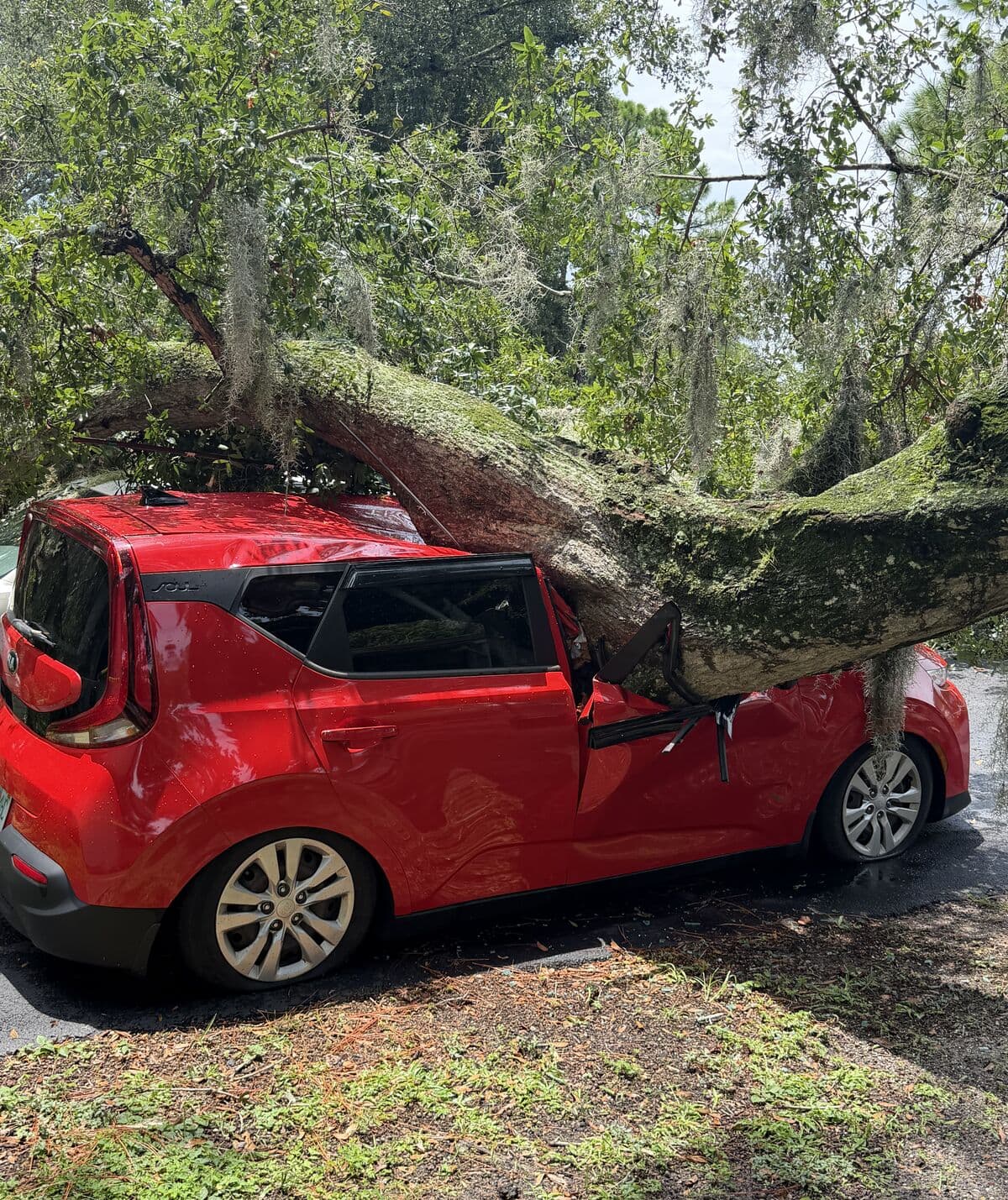
A parking space, a Tuesday, and about four feet
We got called out to an apartment complex in Daytona Beach in late July after a major leader came out of a mature oak in the residential parking lot. It did not take a hurricane to do this. No named storm, no tropical system offshore, nothing anybody boarded up for. Just an ordinary Central Florida summer afternoon, the kind we get sixty of in a row.
The leader landed on a parked car. It caved the roof in, took out the glass, and folded the driver's side. The vehicle is a total loss and nobody is going to argue about that. What I want you to notice is the part that does not show up on an insurance claim: that car was parked in a residential lot, a few feet from a sidewalk, in front of an apartment building where people walk to their vehicles every single morning.
And look at where it hit. Not the hood, not the trunk. It came down across the driver's door and the pillar behind it, and it crushed the roof line down into the driver's seating position. Nobody was in that seat. If somebody had been, we would not be talking about a car.
Nobody was in the vehicle and nobody was walking past it. That is the entire difference between a property damage claim and a fatality, and it was decided by timing. Not by maintenance, not by inspection, not by anything the property did. Timing.
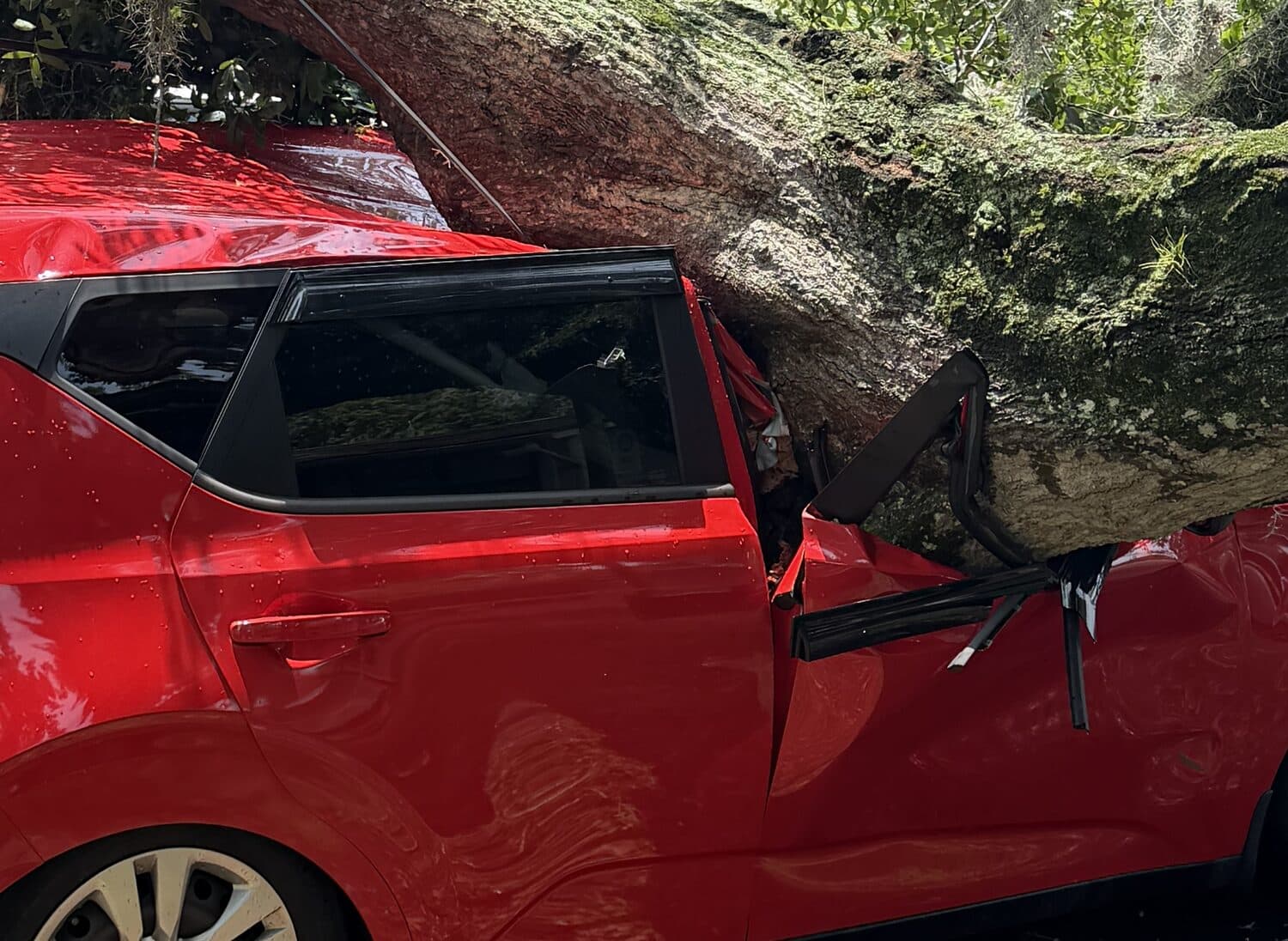
What actually failed, and why that distinction matters
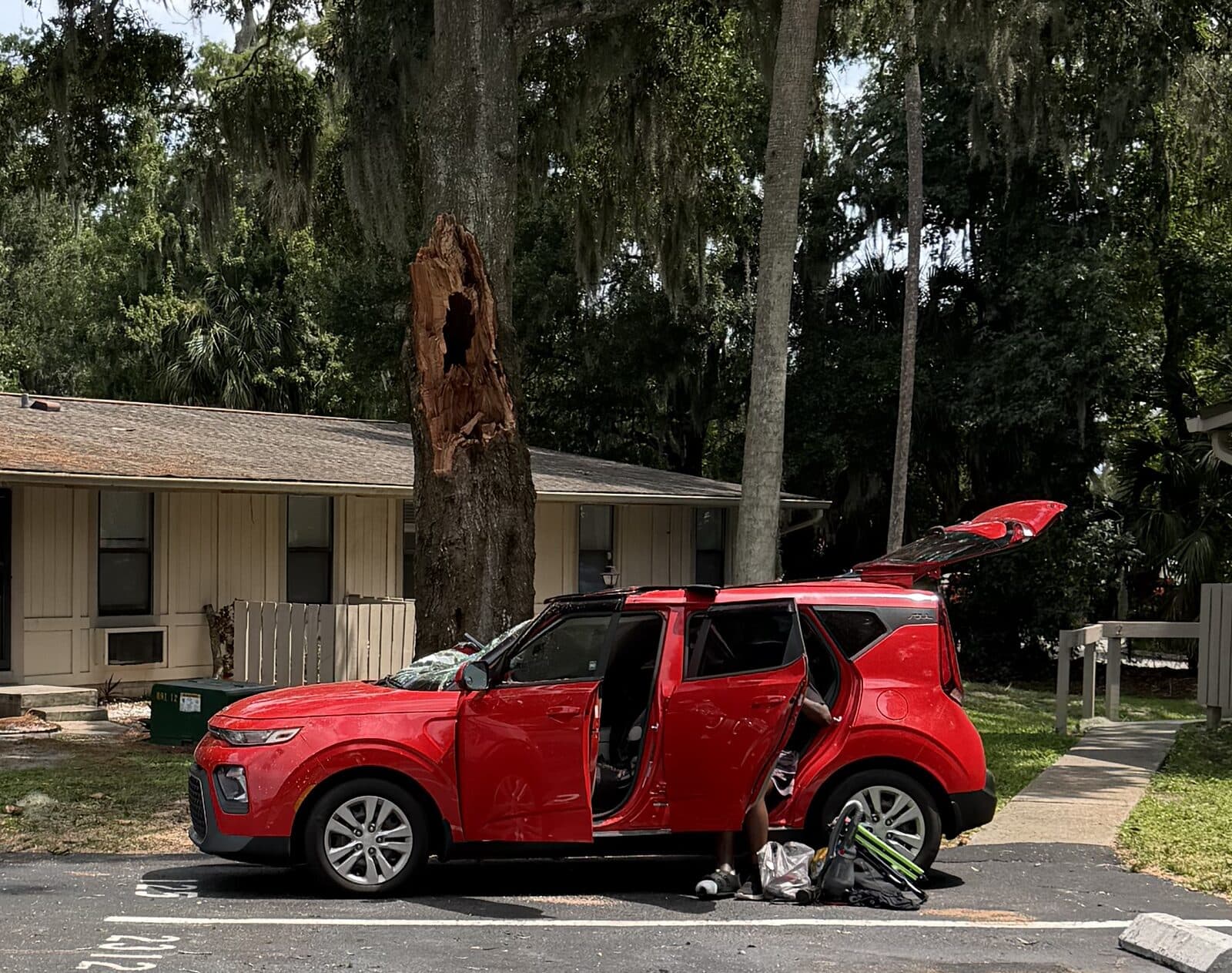
People say a tree fell. This tree did not fall. It is still standing, and from a distance it still looks like a healthy tree with a full green canopy. What failed was a leader, which is one of the large upright stems that make up the main structure of the tree. On a mature oak a single leader can weigh thousands of pounds and carry a third of the canopy.
That distinction matters because whole trees falling over is the failure everybody pictures and plans around. You look at a tree, it is standing up straight, the root plate is not lifted, so it is fine. Leader and limb failures do not work that way. The tree stays vertical and healthy looking while one of its structural parts comes out of it, and the part that comes out is more than heavy enough to kill somebody.
Most of what I get called to look at after the fact is not uprooted trees. It is this.
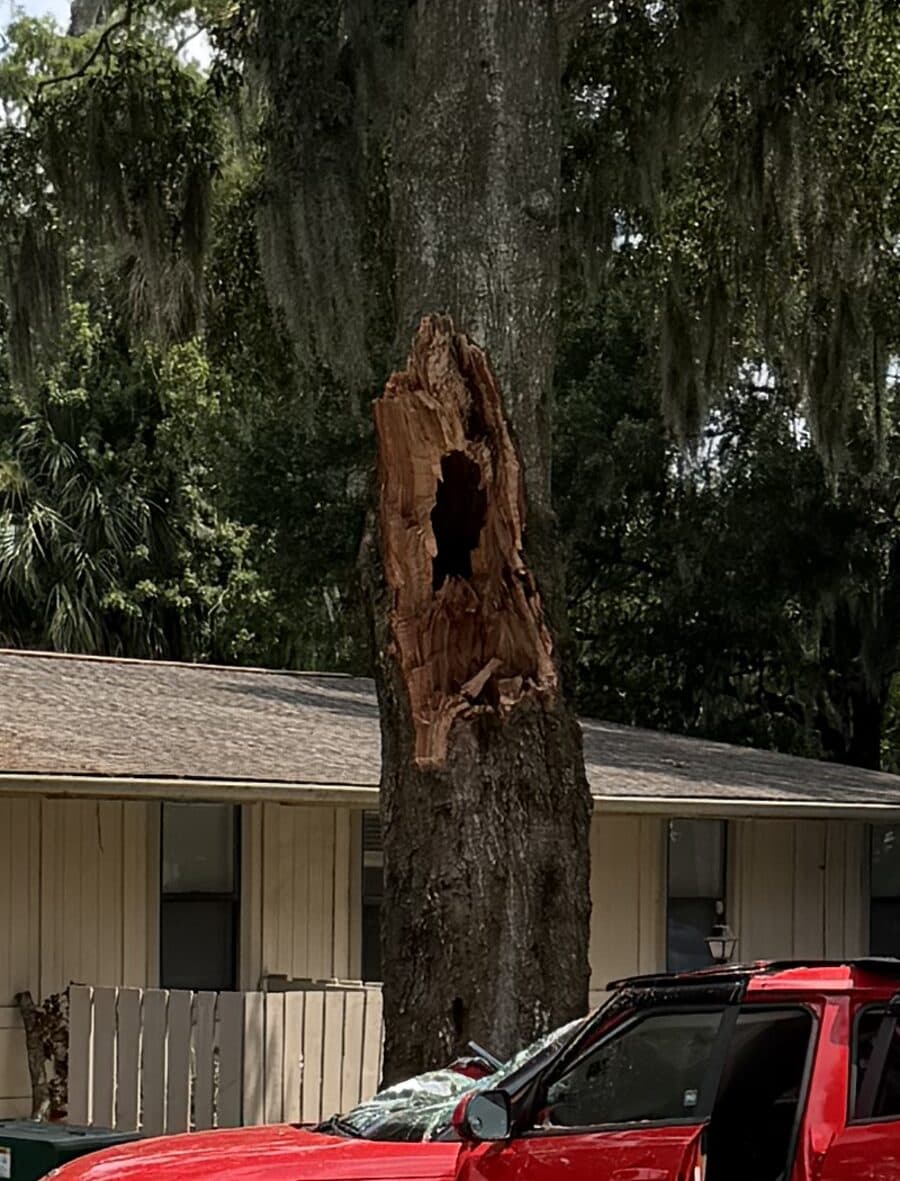
Now look at the failure surface
Here is the photo I want every property manager in Volusia County to look at. This is the stem that leader tore out of, taken from the parking lot once the wood was clear of the car.
That dark opening in the middle is not shadow. It is a cavity. The wood in the center of that stem was gone, consumed by decay, and what was holding the leader on was a shell of sound wood around the outside of a hollow column. The light colored fibrous wood is the fresh failure surface where the remaining shell finally tore. The dark, punky, weathered material inside is the part that had been failing for years.
This is what a decay driven failure looks like, and it is the single most common thing I find when I get called out to a tree that came apart on a calm day. The tree did not die. It did not wilt. It did not drop its leaves and warn anybody. It quietly lost the structural wood in the middle of a major stem while the outside of the trunk stayed covered in intact bark and the canopy above it stayed full and green.
Why nobody saw it from the parking lot
Before the rest of this, one thing worth saying about weather. Our summer afternoons here produce a thunderstorm most days, and one of them may well have been the last push on this leader. That does not make weather the cause. A sound leader on a healthy oak shrugs off an afternoon storm, and does it several dozen times a summer. When one comes out in ordinary weather, the storm is the trigger and the decay is the reason, and it is the decay that was findable in advance.
Which brings up the part that frustrates owners and managers, and it is a fair frustration. Somebody drives that lot every day. Landscapers are on site weekly. Nobody is being negligent by failing to notice a hollow they cannot see.
Decay works from the inside out. A wound from an old storm break, a bad pruning cut, a lightning strike, a mower or trimmer hit at the base, or a limb that tore off years ago gives decay fungi a way in. From there it moves through the heartwood in the center of the stem, which is the part of the tree that carries the structural load but is not alive and cannot defend itself the way the outer wood can. The tree responds by adding new wood on the outside, so the trunk keeps growing, the bark stays intact, and the canopy keeps getting water and nutrients through the outer tissue that is still perfectly healthy.
So you end up with a tree that is genuinely healthy and structurally hollow at the same time. Those are not contradictions. Health and structure are two different questions, and looking at a green canopy only answers the first one.
The clues that do show on the outside are small and easy to walk past. A seam or a healed over wound running up the stem. An old branch stub that never sealed. A bulge or a flattened area where the tree has been adding reaction wood to compensate. Mushrooms or conks at the base or on the trunk, which is decay fungi fruiting and one of the loudest signals a tree can send. A crack at the union where two stems meet. None of that is obvious unless somebody is standing under the tree specifically looking for it.
Why this keeps happening in Volusia County
There is nothing unusual about this tree or this property. Volusia County is set up for exactly this failure, and it is worth understanding why.
We grow big oaks here, and a lot of them are laurel oaks. Laurel oak is everywhere in Central Florida residential development because it grows fast and gives you shade in fifteen years instead of forty. The tradeoff is that it is a short lived oak with weak decay resistance. A laurel oak that went in when an apartment complex was built in the seventies or eighties is now at or past the end of its useful structural life, and the ones that look biggest and most impressive are frequently the most hollow. Live oaks are a far stronger tree, but a live oak with an old wound and forty years of decay behind it will come apart too.
Then add the climate. Heat and humidity nearly year round is ideal for the decay fungi that do this work, so rot moves faster here than it does further north. Add our storm history, because every named storm that has come through Volusia County has left trees with torn limbs and open wounds that never got looked at afterward. A tree that survived a hurricane is not a tree that came through it undamaged. It is often a tree that started a decay column that day and has been quietly working on it ever since.
And add the drainage. Sandy soils, high water tables near the Halifax River and the coastal corridor, and compacted parking lot fill around the root zone all stress root systems and limit how well a tree can compartmentalize damage. Paving over root zones in a parking lot renovation is one of the most reliable ways to start a decline that shows up as a failure a decade later.
The part that should get an owner's attention
In Florida, a property owner owes a duty of reasonable care to the people who live on and lawfully visit the property. On a residential rental property, that includes keeping the common areas in reasonably safe condition. Where trees are concerned, courts have generally looked at whether the owner knew or reasonably should have known about a hazardous condition, and whether they acted on it.
That phrase, should have known, is the whole ballgame. A hollow you cannot see from the parking lot is one thing. A hollow that a qualified arborist would have identified on a routine inspection is a very different thing, and the fact that nobody inspected is not usually a defense. It is closer to the opposite.
So the practical question for an owner or manager is not whether a tree looks fine. It is whether you can show that somebody qualified looked at your trees, when they looked, what they found, and what you did about what they found. That documentation is worth having before an incident, because it is nearly impossible to produce afterward.
I am an arborist and not an attorney, and none of this is legal advice. Talk to your counsel and your carrier about your specific exposure. But every property manager I have had this conversation with has understood the point immediately: the inspection record is the thing you wish you had, and the only time you can create it is now.
What a tree risk assessment actually is
This is not a guy walking the property saying which trees look bad. There is a defined methodology, published by the International Society of Arboriculture, and it is what an ISA Certified Arborist is trained to apply. It comes down to three questions asked about every tree, in order.
- What is the target? A tree in the middle of a retention area with nothing under it is a completely different risk than the same tree over a residential parking lot, a playground, a dumpster pad, a mail kiosk, or a walkway to a building entrance. Risk is failure plus something to hit, and on an apartment property there is almost always something to hit.
- How likely is a failure? This is where the tree gets examined properly. Root collar excavation where it is warranted, checking for decay and cavities, sounding the stem with a mallet to hear where the wood has gone soft, looking at unions between codominant stems, checking for included bark, cracks, conks, past failures, and lean. Where it is called for, this includes instrumented testing that can measure how much sound wood is actually left in a stem.
- What are the consequences if it does fail? A twig is not a leader. Failure of a two thousand pound stem over a parking space with a resident walking to work is a severe consequence, and that rating is what drives the recommendation.
And it ends with a decision, not a report
Those three answers combine into a risk rating, and the rating drives a recommendation you can actually act on and budget for. Sometimes the answer is removal. Far more often it is not, and this is what surprises owners the most.
A lot of what I find gets resolved by reducing the target instead of taking the tree. Move the parking spaces. Relocate the mail kiosk or the bench. Reroute the walkway. Sometimes the answer is a crown reduction or a cabling and bracing system that takes load off a weak union and buys the tree another twenty years. Sometimes it is a scheduled reinspection in twelve months because the tree is fine now but has a condition worth watching.
Removal is the last option, not the first one, and any arborist whose recommendation is always removal is selling removals. On this property, honestly, that tree was almost certainly a removal. But I would rather find that on a Tuesday with a clipboard than on a Tuesday with a crushed car and a police report.
What you can look for yourself, this week
None of this replaces an assessment, but if you own or manage property in Daytona Beach, Port Orange, Ormond Beach, New Smyrna Beach, DeLand, or anywhere else in Volusia County, you can walk your property this week and flag the obvious ones. Look at every tree that has something underneath it worth protecting.
- Mushrooms, shelf fungi, or conks growing on the trunk, at a branch union, or out of the ground at the base. This is decay fungi fruiting. Treat it as a stop sign and get the tree looked at.
- Any cavity, hole, or opening in the trunk or a major limb, including old wounds that look healed over on the surface.
- Two or more large stems that split low on the trunk, especially if the union between them has bark growing into it or a visible crack or seam running down from it. That is where this failure happened.
- Deadwood in the upper canopy, especially large diameter dead limbs. Thin or sparse foliage on one side of the tree compared to the other.
- A trunk that is not round, or has a bulge, a depression, or a vertical seam running up it. The tree is telling you it is compensating for something.
- Soil that is heaving, cracked, or mounded on one side of the base, or exposed roots that have been cut for a sidewalk, utility trench, or parking lot expansion.
- Any tree that has already dropped a large limb. A tree that has failed once is a tree with a failure pattern, and it will usually do it again.
Timing, and the thing that actually gets these done
The honest answer on timing is that the best window in Central Florida is before hurricane season, not after it, and the second best is right now. Trees that are already compromised are the ones that come out in the first real wind event of the season, and by then you are competing with every other property in the county for a crew.
The reason this work does not get done is almost never that an owner does not care. It is that trees do not have a maintenance schedule the way a roof or an HVAC unit does. There is no annual inspection anybody is legally making you do, no vendor calling you about it, and no line item on the budget. So a tree that has been quietly hollowing out for fifteen years never comes up in a single meeting until the morning it lands on somebody's car.
Put it on the calendar like anything else on the property. Once a year on a residential property with people and vehicles under the canopy, and after any storm that does visible damage. It is a small line item compared to what one of these costs.
If you have big oaks over your parking lot
LES is owner operated by an ISA Certified Arborist, FL-9716A, and we work across Volusia, Seminole, Orange, and Lake counties. We do tree risk assessments and tree inventories for apartment communities, HOAs and condo associations, commercial properties, municipalities, and development sites, and we hand back photo documented findings you can put in a file and act on.
We are not a tree removal company looking for removals. We will tell you which trees are fine, which ones need something short of removal, and which ones genuinely need to come down, and we will tell you in that order.
If you manage a property in Daytona Beach or anywhere in Volusia County with mature trees over parking, walkways, playgrounds, or buildings, send us the address and a few photos. We will tell you what we see. And if you have a tree with mushrooms growing out of the trunk over an occupied parking space right now, call us instead of emailing.