
Arborist & Tree Risk
The Tree You Killed During Construction Does Not Die Until Year Four
The tree makes it through construction, gets its certificate of occupancy photo, and dies three years later. Everybody blames drought. It was the grading, and the damage was done in an afternoon.
ISA Certified Arborist FL-9716A · FSESCI Qualified Inspector · Florida GI-BMP Certified · Veteran-Owned
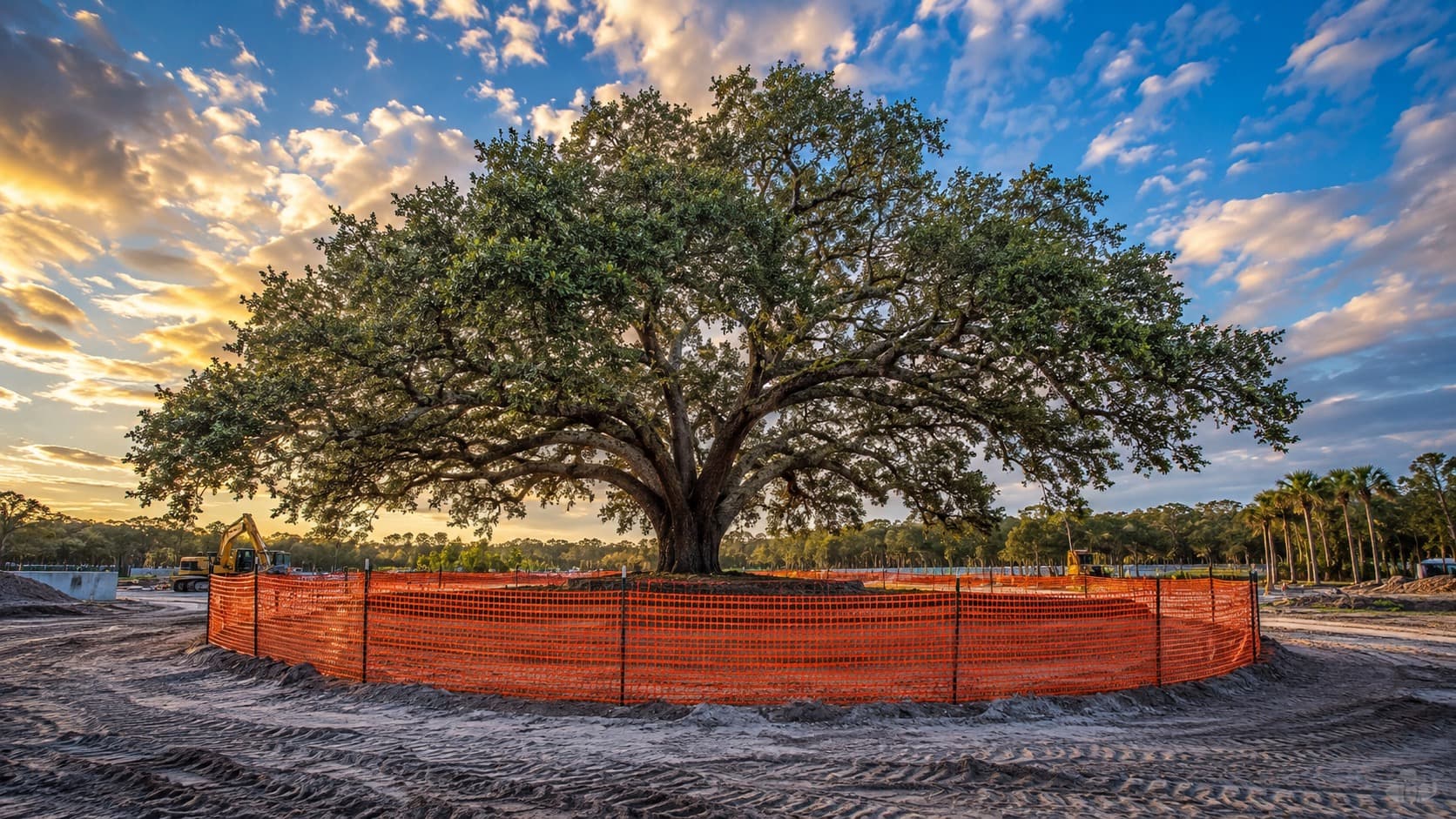
The delayed failure nobody connects back to the job
A developer keeps a big live oak. It is on the landscape plan, it is in the renderings, it is the reason the entry feature looks the way it does. Construction runs, the tree stays standing, everybody signs off, and the project closes out.
Three years later the canopy is thin. Year four there is deadwood through the top and the leaves are small and pale. Year five somebody is getting a quote to take it down, and the explanation everybody agrees on is that we have had some dry years.
It was the construction. Specifically it was something that happened underground, usually in a single afternoon, three or four years earlier. Trees do not die on our schedule. A mature oak has enough stored energy to keep looking fine for years after it has lost the root system that was supporting it, which is exactly why this cause and effect almost never gets connected.
Where the roots actually are
Almost everything that goes wrong here comes from one wrong mental picture. People imagine roots as a mirror image of the canopy, going deep, tapering down into the ground like the tree is a hand gripping the soil.
That is not how it works, and in Central Florida it is really not how it works. The great majority of a tree's absorbing roots sit in the top 12 to 18 inches of soil, and they extend well past the edge of the canopy, often two to three times the radius of the drip line. On our sandy soils with seasonally high water tables, roots stay shallow and spread wide because that is where the oxygen and the water are.
So the root system of that live oak is a wide, shallow plate reaching far out under where you were planning to put the parking lot. Not a deep anchor under the trunk. Once you have that picture right, everything else on this list becomes obvious.
The four things that actually kill them
Equipment striking the trunk is the damage everybody worries about, and it is the least of it. It is visible, it gets reported, and it is usually survivable. The failures that matter are the ones nobody writes an incident report for.
- Grade changes. Cutting grade inside the root zone severs a large share of the absorbing roots in one pass. Filling over it is worse in a way that surprises people: adding even a few inches of fill over a root system smothers it, because those roots need gas exchange with the surface and you have just sealed it. Fill is the quiet killer, because nothing looks damaged afterward.
- Trenching. A single utility trench cut straight across the root zone can sever a very large fraction of the root system on that side. Water, sewer, electric, irrigation, fiber, and drainage all get trenched, usually by different subs on different days, and none of them are thinking about the tree. Trees that lose roots on one side also become structurally unstable on that side, which is a risk problem on top of a health problem.
- Compaction. This one gets ignored because there is nothing to see. Loaded equipment, stockpiles, staging, and even repeated pickup traffic over the root zone compress the soil and collapse the pore space that roots need for oxygen and water movement. Compacted soil is close to permanent on a construction timescale. You cannot fix it by watering.
- Storage and washout. Material stockpiles, fuel, and concrete washout parked over a root zone do chemical and physical damage together. Concrete washout in particular drives soil pH high enough to make a site genuinely hostile to the tree, and it happens because the shade under the tree is the most comfortable place on the site to park things.
What a tree protection zone actually is
A tree protection zone is a fenced exclusion area around a retained tree that nothing enters. No equipment, no traffic, no storage, no stockpiles, no washout, no trenching, and no grade change. That is the whole concept, and its simplicity is the point, because it has to survive being enforced by people who are not arborists.
The zone is sized off the critical root zone. The common rule of thumb is a radius of one foot for every inch of trunk diameter at breast height, so a 30 inch DBH oak gets a 30 foot radius. That is a floor, not a target. Species matters, age matters, soil matters, and existing condition matters, and on a mature specimen tree that is worth protecting you often want more than the rule of thumb gives you.
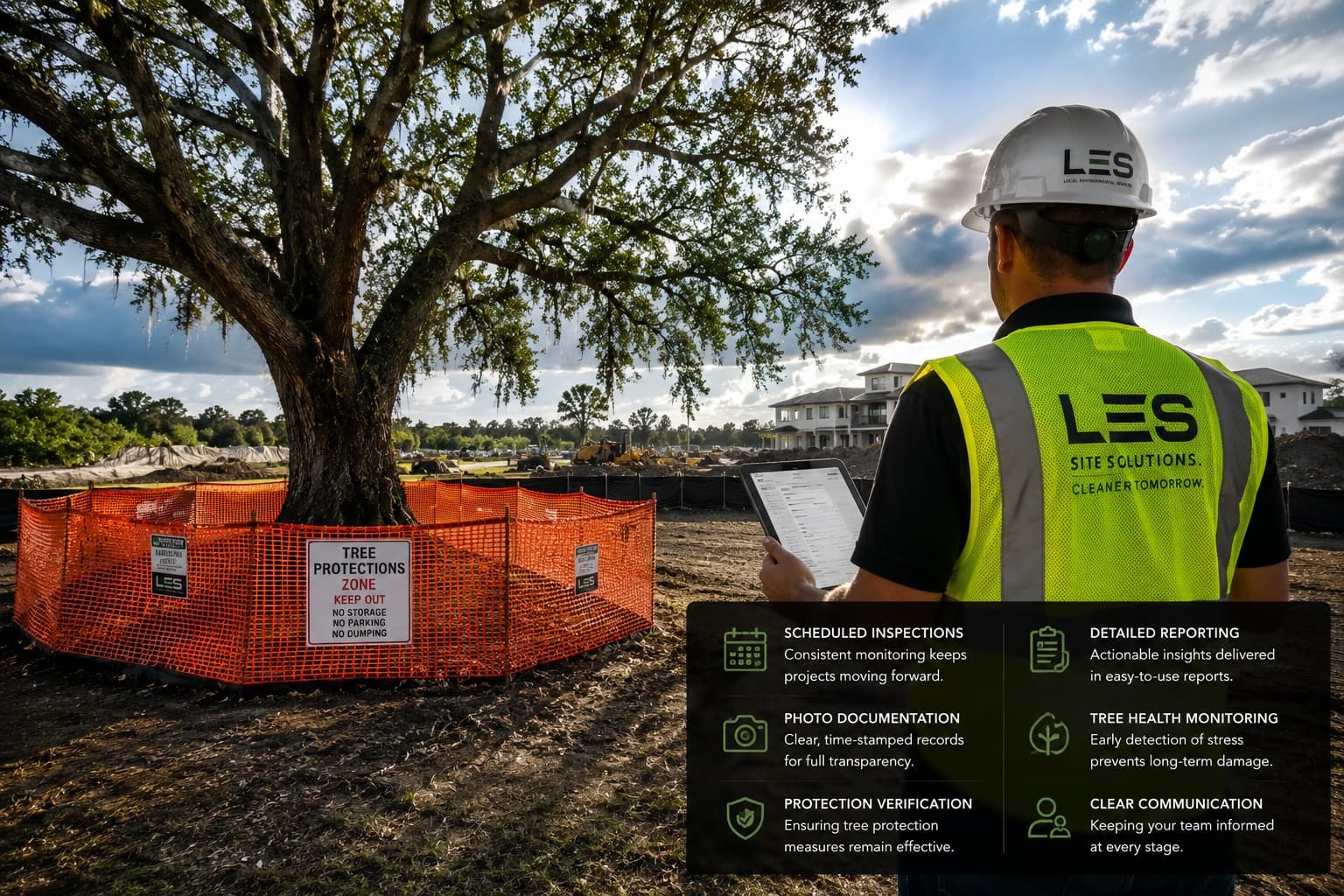
The fence has to be real. Orange plastic mesh stapled to a few stakes gets flattened by the first piece of equipment that needs to get by, and once a fence has been moved once it is gone for the rest of the job. Posts driven properly, rigid fencing, signage that says what the zone is, and a location that got set before mobilization rather than after.
The sequence that makes it work
Tree protection fails on schedule far more often than it fails on technique. The measures themselves are not complicated. Getting them in at the right point in the job is the whole thing.
It starts before anything moves, with an inventory that establishes what trees exist, their species, DBH, condition, and disposition, tied to the survey or base plan. That is what the protection plan gets built from and what the permit conditions get written against. Then the protection zones go in before clearing and grading mobilize, not after the first pass, because after the first pass the damage you were protecting against has already happened.
Clearance pruning happens before equipment arrives, not when an operator finds a limb in the way. A limb removed by an arborist to a proper cut is a wound the tree closes. A limb torn off by an excavator boom is a wound that never closes and starts a decay column, which is how a tree that survived construction becomes a tree that drops a leader onto a parked car fifteen years later.
And then somebody actually checks. Zones drift. Fences move. A new sub shows up in month four who was not at the preconstruction meeting and sees a nice shady flat spot to stage pipe. Scheduled inspections through construction, with photo documentation, is what keeps a protection plan from being a sheet in a drawer. It is also the record that shows the project met its permit conditions when somebody asks at closeout.
Why this is worth real money to a project
Retained trees are usually a permit condition, not a preference. Approved tree preservation plans have teeth, and damaging or losing a tree you committed to preserving can mean mitigation planting assessed on diameter, replacement costs, code enforcement, and holds at inspection or certificate of occupancy. Mitigation math on a large specimen tree gets expensive quickly, because it is calculated on the size of what was lost.
There is the asset side too. A mature canopy tree is one of the few things on a site that cannot be bought and installed. It is why the entry feature works and why the amenity space is usable in a Florida summer, and no amount of landscape budget replaces a 36 inch live oak in the timeframe anybody cares about.
And there is the risk side, which is the one this article circles back to. Construction damaged trees do not simply decline politely. They lose roots on one side and become unstable. They start decay columns at torn limb wounds. Then they stand over the parking lot of the finished project for the next thirty years while everybody assumes they are fine.
If you have trees on an approved plan
LES handles this across Seminole, Orange, Lake, and Volusia counties, and we do both halves of it. The arborist side is the inventory, the protection planning, the reporting, and the documentation your reviewer and your project file need. The field side is installing the protection, doing the clearance pruning, and inspecting through construction so the plan survives contact with an active site.
That combination is deliberate. The usual failure mode is a consultant who writes a plan and never returns, and a crew that installs a fence without knowing what it is for. One accountable party for both is how the trees on the plan are still there, and still sound, at closeout.
Send us the tree survey, the site plan, the approved preservation plan, or the municipal comments, and we will tell you what the field scope actually needs to be.